
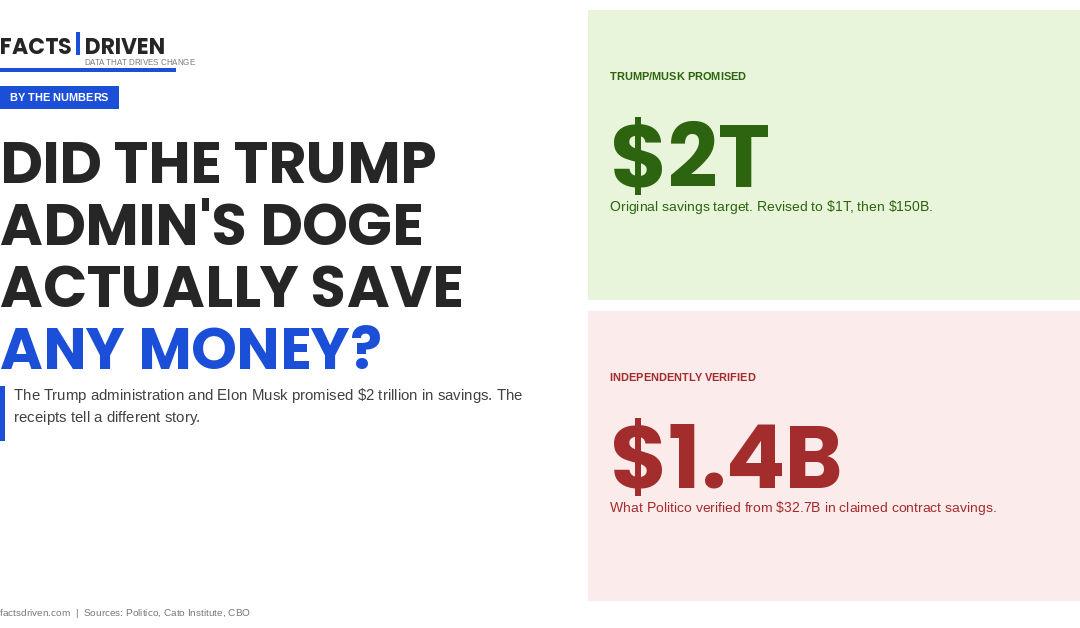
The Trump administration and Elon Musk took the stage at CPAC in February 2025, Musk literally holding a chainsaw, and promised to cut $2 trillion from the federal budget. The visual may have been compelling for some, but the numbers, it turns out, tell a very different story.
DOGE was dissolved as a standalone entity by November 2025, and its work folded back into the agencies it had spent a year cutting. What it left behind was a heated dispute about what actually happened: how much was saved, how much was wasted, and whether the whole operation ended up costing taxpayers more than it returned.
Here’s what the data shows.
The promise vs. the receipts
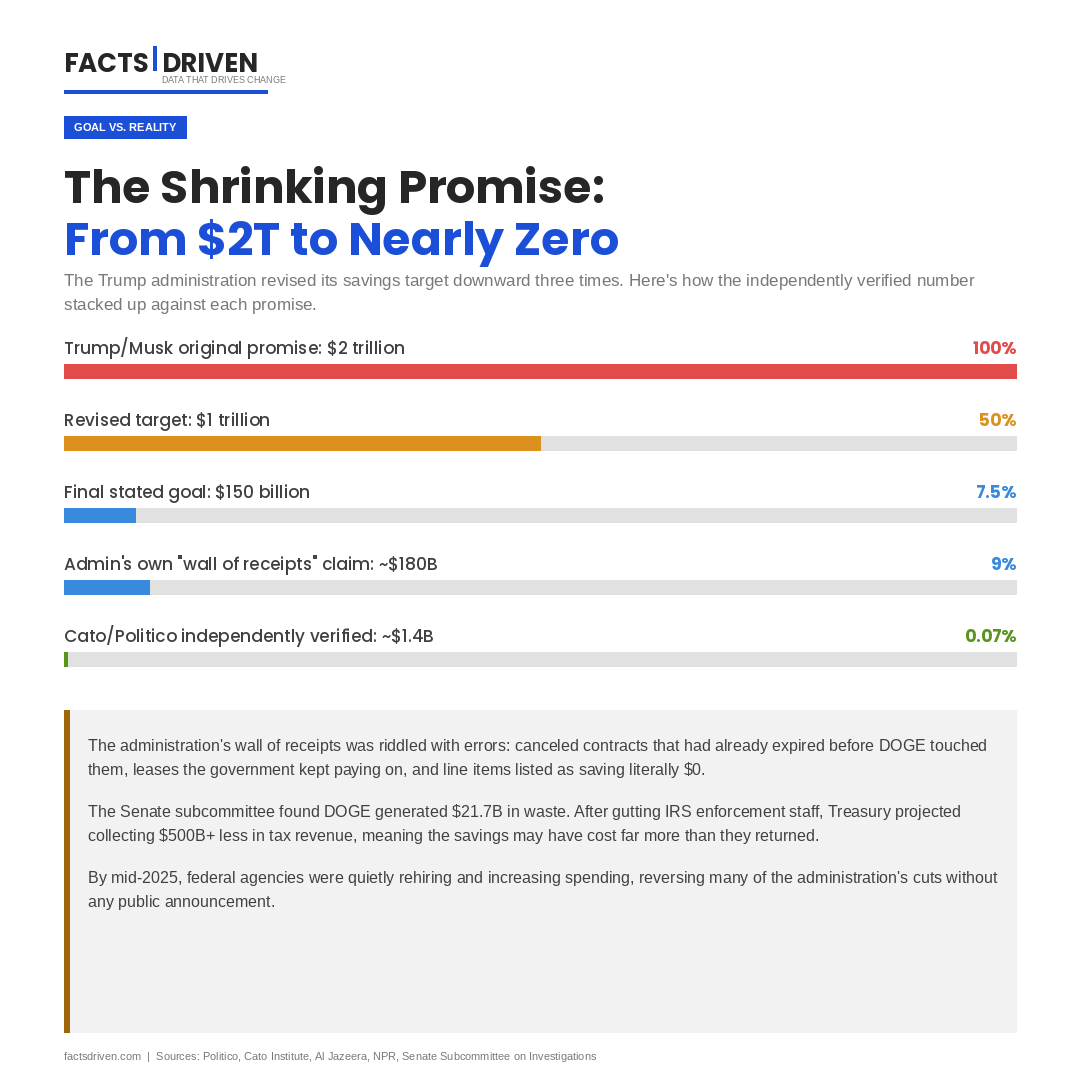
The Trump administration’s original target was $2 trillion in annual savings. By spring 2025, that had been revised to $1 trillion, then again to $150 billion. The administration’s own “wall of receipts,” its public accounting of cuts, eventually claimed around $180 billion. Independent analysts looked at that number and found it didn’t hold up.
Politico audited $32.7 billion in the administration’s claimed contract savings and could verify $1.4 billion of it. The Cato Institute, which broadly supported the goal of shrinking government, concluded in January 2026: “DOGE had no noticeable effect on the trajectory of spending.”
The wall of receipts itself was riddled with errors. DOGE cancelled contracts that had already expired before they had even touched them. There were leases the government stopped claiming to pay, while still paying them. At one point, Trump Admin officials took credit for canceling a lease on a location for Obama’s Presidential Library records. However, the leasing company told PolitiFact the government never actually left and kept paying rent.
In the end, the Senate subcommittee on investigations found that across its operations, DOGE generated $21.7 billion in waste.
Spending went up, not down
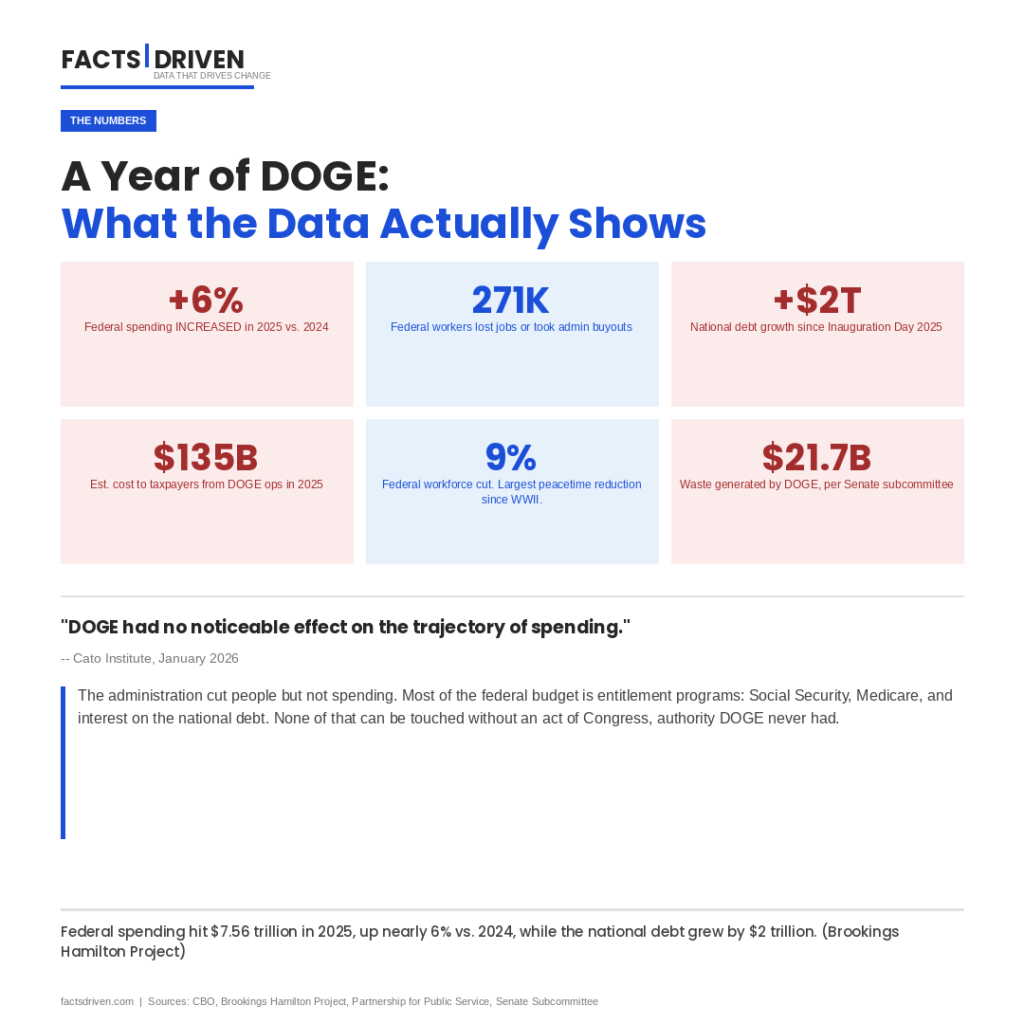
Federal spending hit $7.56 trillion in 2025, up nearly 6% from 2024, according to the Brookings Hamilton Project. The national debt grew by more than $2 trillion from Inauguration Day. The federal deficit expanded by $76 billion compared to the prior year.
Why didn’t the cuts work? Because most of the federal budget is congressionally mandated spending: Social Security, Medicare, Medicaid, and interest on the national debt. The Trump administration could not cut any of that by executive order. You need Congress to pass a law authorizing that. The discretionary spending that DOGE could actually touch is a small slice of the total, and even there, many cuts were contested, litigated, and quietly reversed within weeks or months.
By mid-2025, federal agencies were rehiring workers and increasing spending, undoing many of the administration’s cuts without any public announcement.
The hidden costs
This is where the story gets worse.
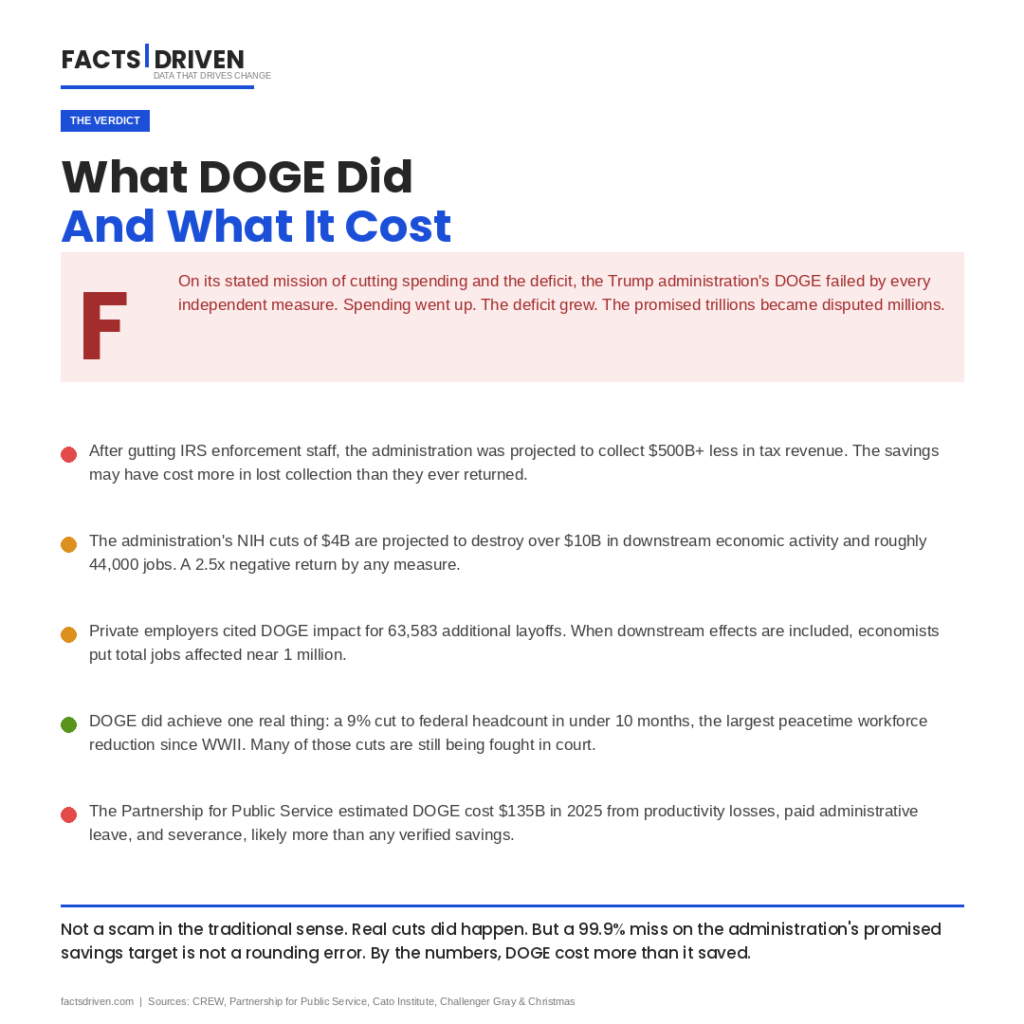
The IRS was one of the administration’s early targets. After DOGE gutted its enforcement staff, Treasury officials projected the federal government would collect $500 billion or more less in tax revenue by April 2025. That is not a savings. That is the opposite of a savings. The point of an IRS enforcement agent is that they collect more than they cost, historically a significant multiple. Firing them to save money on salaries while losing hundreds of billions in uncollected revenue is not fiscal discipline.
The administration cut $4 billion from the National Institutes of Health. That sounds like savings until you look at how NIH funding works. Studies have found that NIH awards generate a return of more than 2.5 to 1 in new economic activity. The $4 billion in cuts is projected to destroy over $10 billion in downstream economic activity and roughly 44,000 jobs, many of them at universities and research hospitals across the country.
The ripple effects went further than federal agencies. Private employers cited “DOGE impact” as the reason for 63,583 additional layoffs. When you include downstream effects through contractors, grantees, and the communities that depended on that spending, economists put total jobs affected near one million.
The Partnership for Public Service estimated the DOGE operation cost taxpayers $135 billion in 2025 alone, from productivity losses during the chaos of mass layoffs, workers placed on paid administrative leave while litigation played out, and the cost of severance and eventually rehiring people the administration had fired. That estimate did not include lost tax revenue or the cost of ongoing lawsuits.
What DOGE did actually accomplish
To be fair (LOL): the administration did achieve one thing by the numbers. Federal headcount dropped 9% in under 10 months, from about 3 million civilian workers in January 2025 to 2.74 million by November. The Cato Institute called it the largest peacetime workforce reduction since the military demobilizations at the end of World War II. (Yikes)
Whether that reduction sticks is another question. Federal courts blocked several major layoff efforts, finding the administration had failed to follow established legal procedures. Many fired workers were reinstated. The final scope of the workforce reduction remains unsettled in court.
And as Cato also noted, cutting the federal workforce does not automatically cut spending. Federal workers account for roughly 8% of total government outlays. The rest is transfer payments: Social Security checks, Medicare reimbursements, debt interest. You can eliminate every federal worker and the budget barely moves.
The verdict
A 99.9% miss on the administration’s promised savings target is not a rounding error. It reflects a fundamental gap between what the Trump administration promised the American public and what the structure of the federal budget actually allows an executive order to accomplish.
The Cato Institute, which wanted DOGE to succeed, put it plainly: the operation failed to reduce spending. The Senate subcommittee found it generated more waste than it eliminated. The Partnership for Public Service estimates it cost more than it saved.
By the numbers, DOGE was the most expensive government efficiency initiative in modern American history.
Sources: Cato Institute (January 2026), Politico, Congressional Budget Office, Partnership for Public Service, Brookings Hamilton Project, Senate Subcommittee on Investigations, Al Jazeera, NPR, U.S. Treasury Monthly Statements, Citizens for Responsibility and Ethics in Washington, Challenger Gray & Christmas. All figures are from independent reporting, not DOGE’s own claims.