
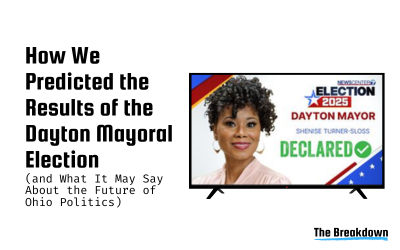
When Dayton voters headed to the polls on November 4, 2025, many expected a close contest. Yet weeks earlier, a FactsDriven survey of likely voters had already captured the underlying dynamics shaping the race, and the poll ended up forecasting the outcome with remarkable precision.
Our final pre-election model showed Commissioner Shenise Turner-Sloss holding a durable lead over incumbent Mayor Jeffrey Mims Jr., particularly among voters most likely to cast ballots in Dayton’s traditionally low-turnout municipal elections. When the official results came in, they validated the accuracy of the model and the broader story the data told about the shifting political landscape in Dayton and potentially across Ohio.
A Poll That Saw the Race Clearly
The poll was fielded October 23 through October 31 and used a Low Turnout Efficient model designed specifically for off-year municipal elections. Weighting by age, race, and gender produced a likely electorate that closely resembled who actually voted, and this alignment was the key to the poll’s accuracy.
Our final weighted topline showed:
- Turner-Sloss leading by a mid single-digit margin
- Stronger performance in younger, predominantly Black west side ZIP codes
- Mims performing best among older, White voters and moderate Democrats on the city’s east side
On Election Night, Turner-Sloss ultimately won by a margin that was within our poll’s ±6% margin of error. This demonstrated the strength of targeted turnout modeling even in small and volatile electorates.
What the Demographics Told Us
Race and Neighborhood Lines Were Central
Turner-Sloss received her strongest support from Black voters, who backed her by large margins. In ZIP codes such as 45406 and 45417, her advantage exceeded 20 points.
White voters leaned narrowly toward Mims, especially in ZIP codes such as 45410 and 45414, although not by margins large enough to counteract her strength in the west side neighborhoods.
Younger Voters Powered the Shift
Voters under 45 favored Turner-Sloss by substantial margins. This reflected a generational shift in what Dayton voters expect from city leadership. These voters prioritized community investment, neighborhood revitalization, and new approaches to public safety and development.
Voters aged 65 and older favored Mims, although the size of this group was smaller than in past municipal cycles.
Gender and Partisan Leaning Showed Subtle Fault Lines
Women preferred Turner-Sloss by double digits. Men were more evenly split, with a slight edge toward Mims.
Although the race was officially nonpartisan, registered Democrats favored Turner-Sloss by a meaningful margin. Independents also leaned toward her, which suggested that her message resonated beyond traditional partisan boundaries.
ZIP Code Patterns Revealed Geography of Support
Turner Sloss’s strongest ZIP codes included 45402, 45405, and 45417. These areas tend to be younger, more diverse, and have higher proportions of renters.
ZIP codes such as 45410 and 45414, which have older and more established homeowners, showed tighter margins or slight Mims advantages.
Issue 9 Was a Policy Signal Beyond the Mayoral Race
Issue 9, the ballot proposal to fund a new public hospital and emergency medical center, received broad support citywide. Our poll found around 61 percent support for the measure, and the election results confirmed strong public backing.
Support for Issue 9 closely mirrored support for Turner-Sloss. Younger voters and Black residents saw Issue 9 as both a health equity investment and a job creator. Older voters and homeowners supported it at slightly lower but still majority levels.
The geographic overlap between Turner-Sloss support and Issue 9 support suggested that the same coalition powered both.
What This Means for the Future of Ohio Politics
1. Local turnout models have become more accurate and more influential.
Even as national politics has grown polarized, the Dayton poll showed that municipal elections can be forecast accurately when demographic turnout modeling is done correctly. Campaigns that rely on intuition instead of data may misread their own electorate.
2. Younger and more diverse voters are reshaping urban politics.
Turner-Sloss’s performance mirrored patterns emerging in other Ohio cities such as Columbus, Cincinnati, Cleveland, and Toledo. Younger and more diverse coalitions are beginning to define urban elections, and this trend may accelerate in future cycles.
3. Voters are showing renewed interest in issue-based politics.
Issue 9’s success demonstrated that voters respond strongly to tangible policy proposals that affect health, equity, and neighborhood conditions. This may foreshadow more successful local ballot initiatives statewide.
4. Municipal elections may preview broader political realignment.
Ohio has leaned more conservative in recent statewide elections, but cities such as Dayton continue to elect younger, reform-oriented candidates. These shifts often serve as early indicators of statewide (and even national) political change.
Methodology
The FactsDriven poll surveyed 240 likely voters in Dayton between October 23 and October 31, 2025. The sample was drawn from the voter file through SMS and online outreach. Responses were weighted by age, race, and gender to reflect expected low turnout conditions typical of off-year municipal elections. The poll had a margin of error of plus or minus 6 percentage points at the 95 percent confidence level.
About FactsDriven
FactsDriven is the research and analytics arm of Heartland Next. We provide data-driven insights that power better policy, smarter campaigns, and stronger communities. We turn complex information into clear, actionable intelligence that helps organizations, advocates, and decision makers lead with confidence.